The DS that cut the cost of onboarding new clients
How design stopped starting from scratch with every client, and began to scale with the business.
- Role
- Senior Product Designer at Accedo, technical lead of the design system
- Client
- Accedo (internal product; clients under NDA)
- Period
- Sep 2024 – Sep 2025 · 2-month POC + 8 months of build · the system kept evolving after I left
- Platforms
- Core, Web, iOS, Android, CTV · 8+ devices
- Team
- 3 designers in Canada, Hungary and Singapore, scoped and reviewed by me · 1 developer on the POC · Elevate engineering
- Results
- ↓56% design and dev hours on client setup
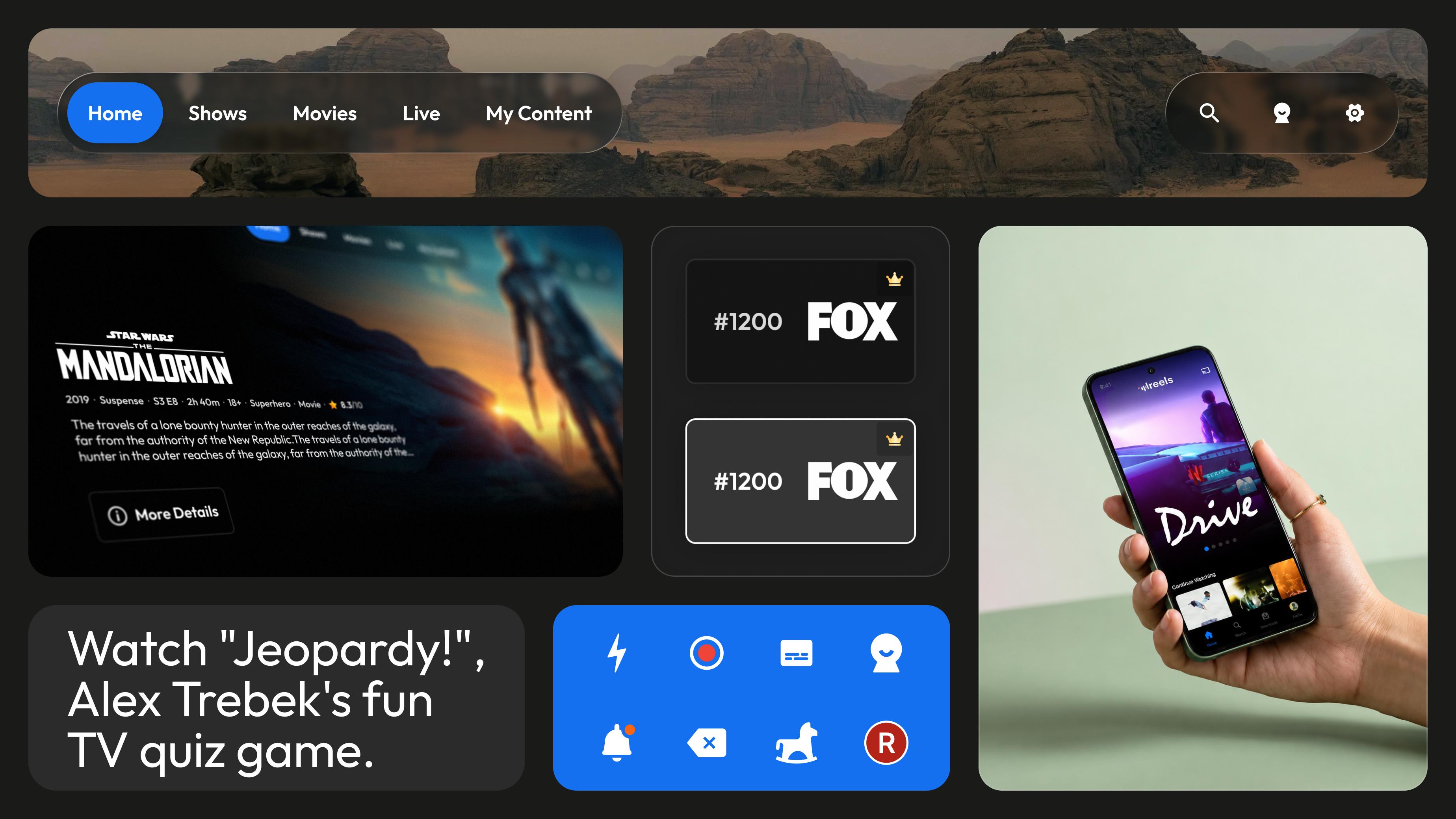
About the client
Accedo sells video streaming in two ways: it builds the app from scratch, or it delivers Elevate, its white-label product that each client customizes with its own brand. Both paths serve the same kind of client, with almost identical needs.
But with every new client, even on pure consulting work, design started from zero. Engineering had a large component library. Design had nothing centralized.
The Reels Design System became one source of truth between design and code.
↓56%
design and dev hours on client setup
Internal estimate, based on the historical average of sold hour scopes
4-5 days
to create a new feature, down from 2-3 weeks
Internal estimate, same base
8+
devices on one system
Accedo, internal
The challenge
Inconsistency across web, mobile and TV turned into constant rework, as early as ideation.
The system had to do three things at once: be platform-agnostic, be shareable with the client and be customizable right in Figma. All without losing consistency across dozens of client and platform combinations.
I led the solution as its technical lead: I set the scope and reviewed the work of three designers in Canada, Hungary and Singapore.
Numbers that won the argument
Not everyone bought the idea. Design tokens, code, a hybrid way of working: part of the team saw it as a risk.
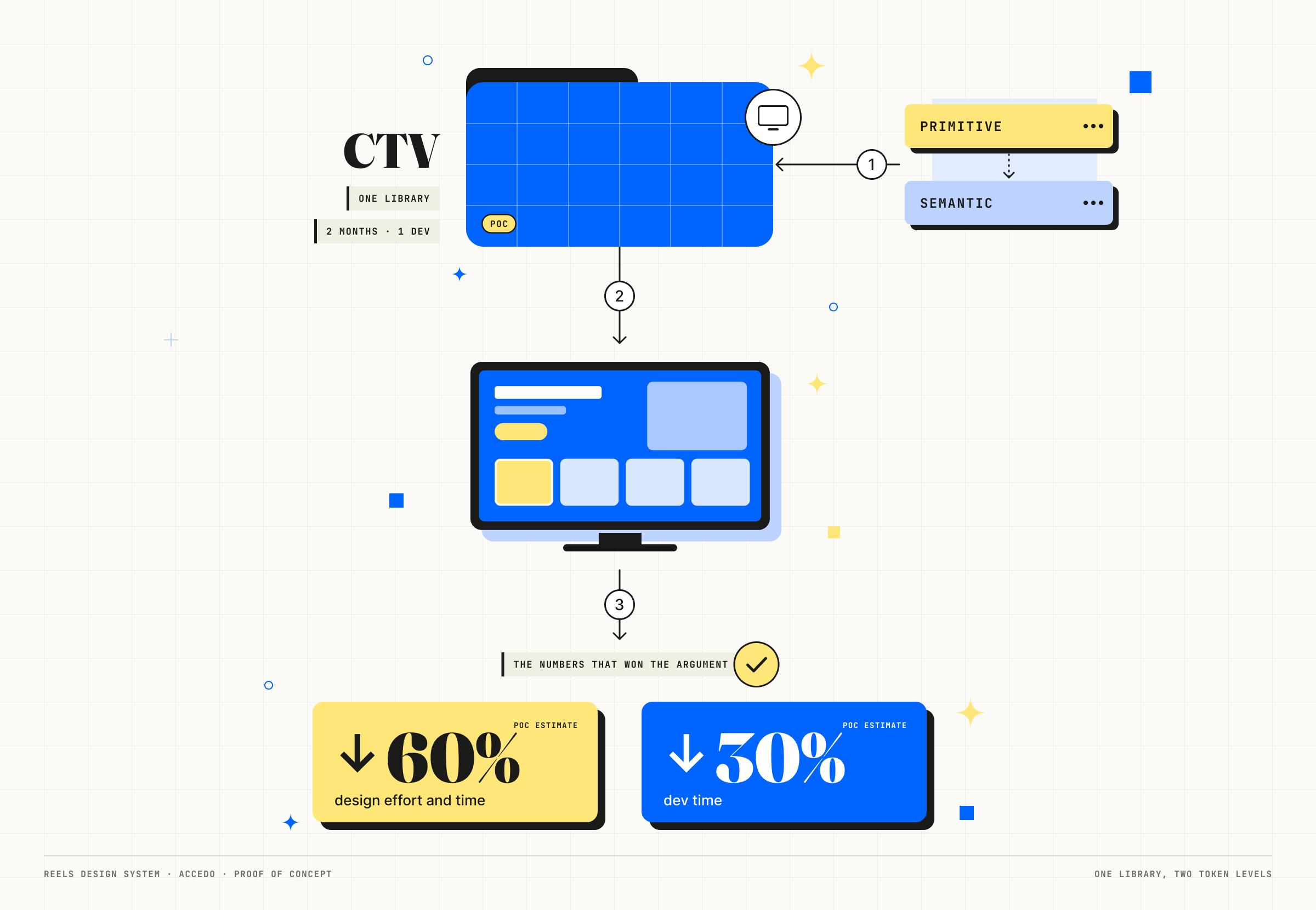
So I spent two months with a developer on a proof of concept for CTV, our main platform. One library, two token levels: primitive and semantic.
Elevate’s engineering pushed back: too much time to build. What turned it around were the POC’s own numbers, a real cut in the time and cost of setting up a new client.
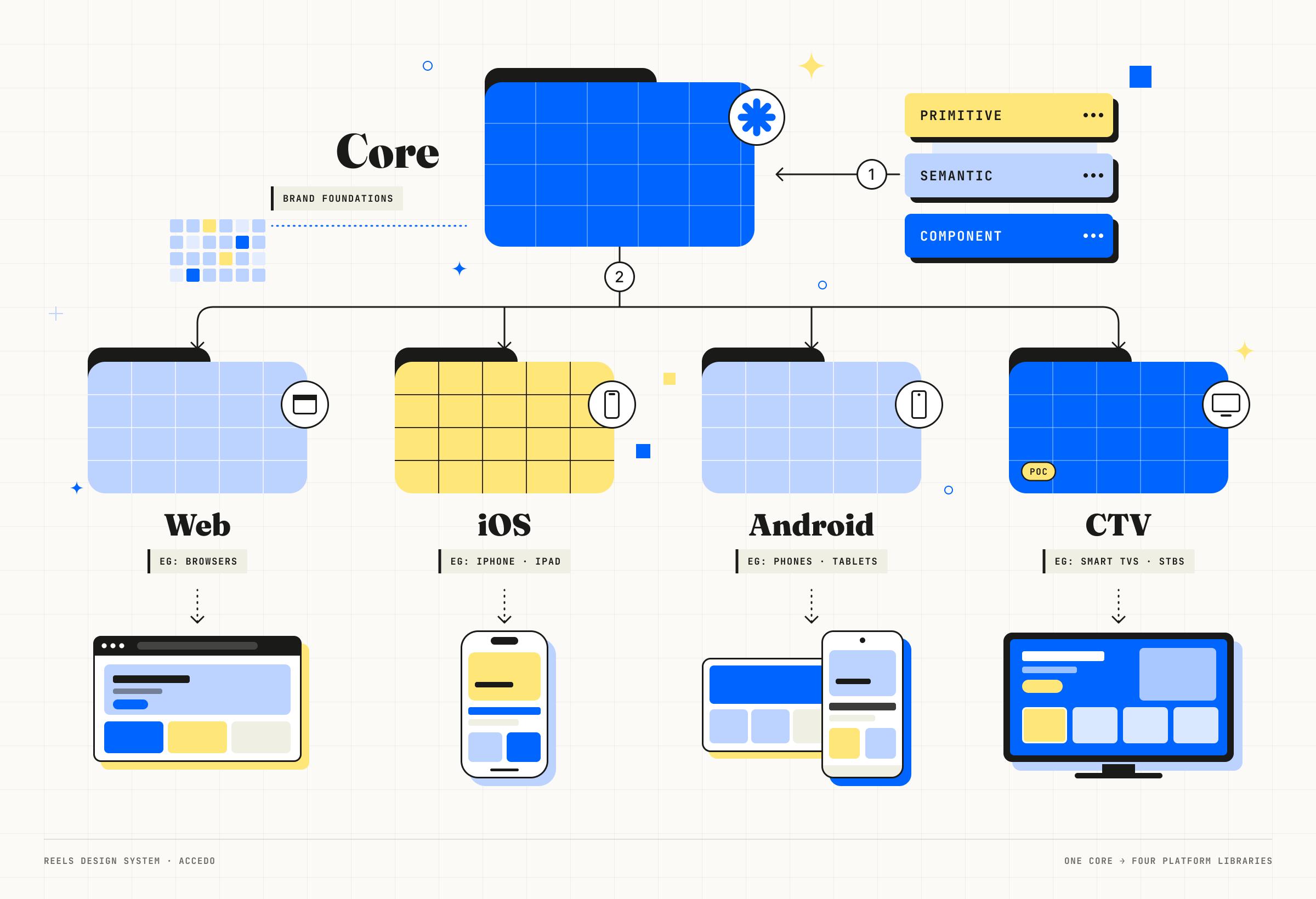
One core, four platform libraries
The simple structure wouldn’t hold at real scale. A semantic token reused too often tied everything together. Files got heavy. And every operating system’s rules, in one library, became too much to manage.
So we split it. A third token level, component, lets us adjust one piece without breaking the rest. And libraries by scope: a Core with the brand foundations, plus one each for Web, iOS, Android and CTV, with their own breakpoints and components.
More power brought more complexity. Onboarding got harder, so we added videos and documentation. We built for eight months and launched every platform at once, because no real client uses just one.
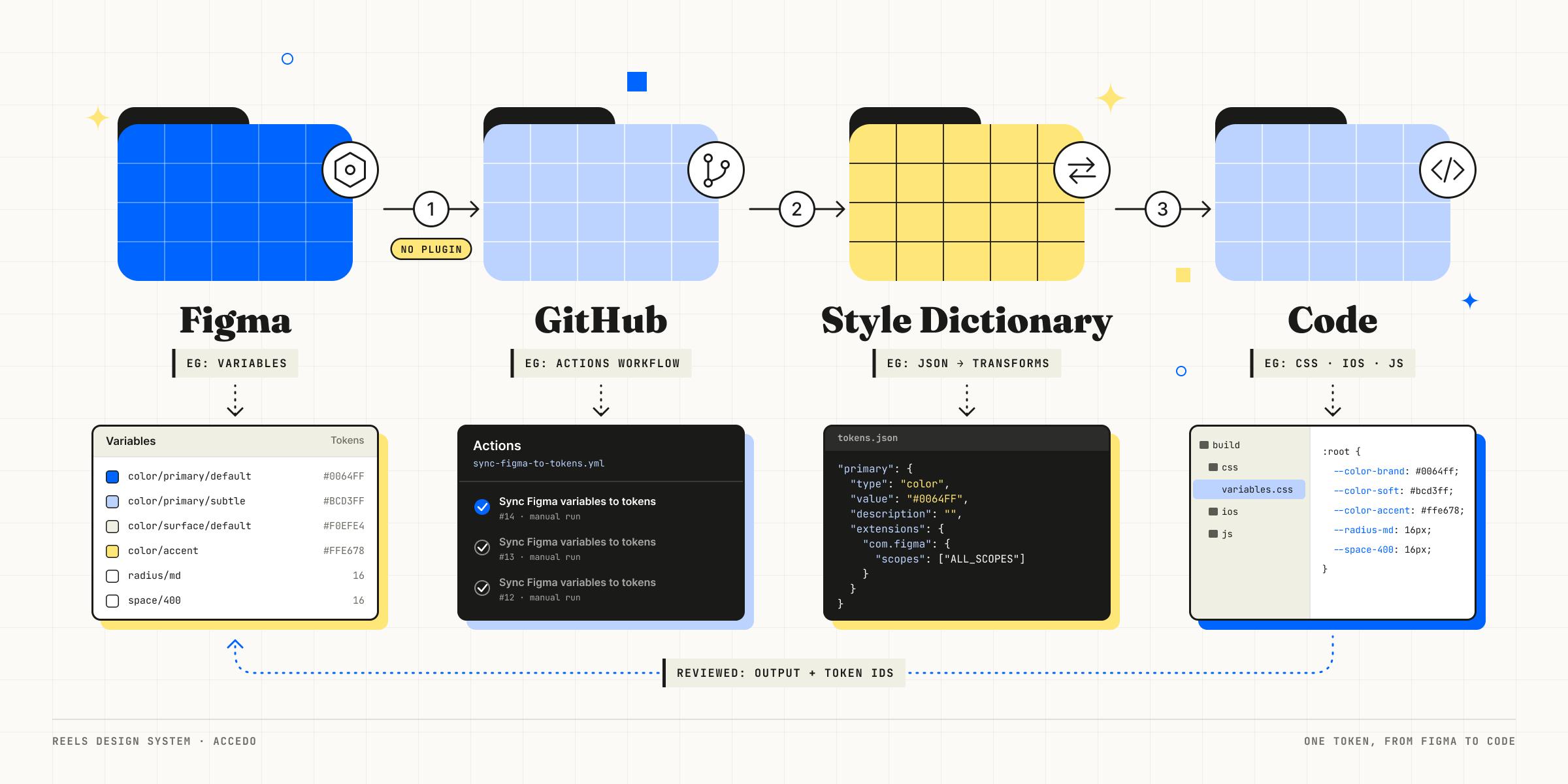
Figma variables straight to GitHub
Tokens live as Figma variables and turn into code in GitHub through Style Dictionary, with no plugin in between. Engineering built the connection. I checked what it generated and the token IDs.
Reviewing work across three countries
The team was in Canada, Hungary and Singapore, and each region read the interface differently. Those differences became regional component variants inside the system.
It was my first time running design operations at this scale. Leading people turned out to be harder than leading tokens.
Where it landed
- ↓56% in design and dev hours to set up a new client (internal estimate, based on the historical average of sold hour scopes).
- From 2-3 weeks to 4-5 days to create a new feature (internal estimate, same base).
- From reactive to proactive: components are validated once, at the source, not on every delivery.
- 8+ devices on the same system.
- Designers stopped redrawing screens and started solving the client’s problem. For me, probably the biggest result.
Highlights
- Led the design system as its technical lead, scoping and reviewing the work of three designers in Canada, Hungary and Singapore.
- Built a CTV proof of concept with a developer and used its numbers to win over Elevate’s engineering.
- Defined the token architecture in three levels and the split into a Core and four platform libraries.
- Checked token generation and IDs in the Figma-to-GitHub pipeline.